Week of May 17-23, 2026
That brilliant light now glistening in the west at sunset is again the "star" of the show. It is, of course, the planet Venus, and this week it'll pair up with two other celestial wanderers: Jupiter and the moon.
Jupiter, another very bright planet, has been descending farther to the west as the spring months progress, and it is now approaching a close encounter with Venus by the end of the month. This occurs because these worlds, along with the Earth, orbit the sun, and our constantly changing viewpoint makes them appear to drift slowly against the more distant and "fixed" stars.
Over the next week, though, another solar system body will enter the scene: the moon. Since our celestial neighbor orbits the Earth once a month, we can see it change its position in the sky from night to night.
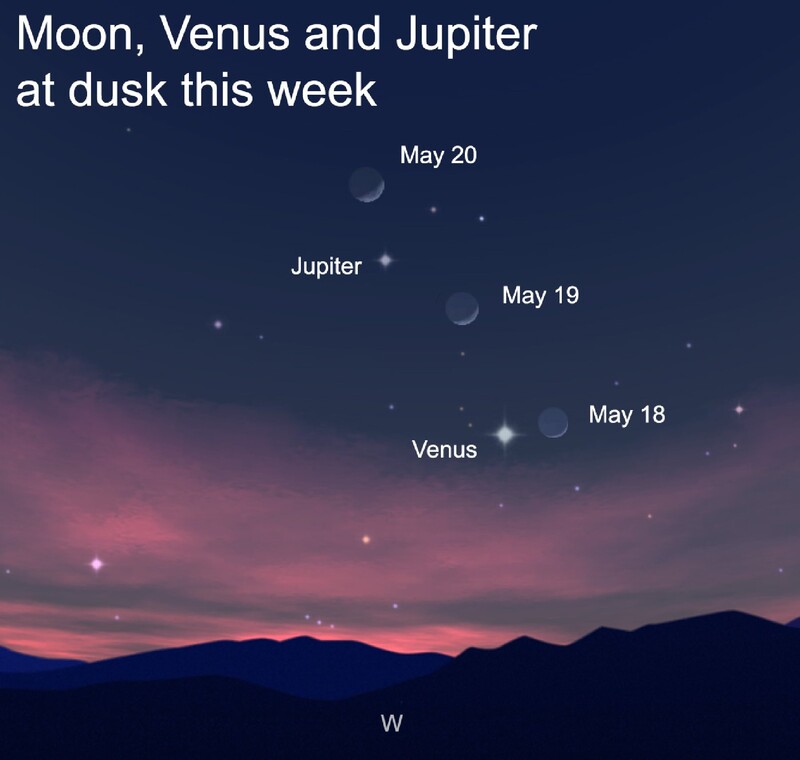
Shortly after sunset on May 17, you might try searching very low in the west for the tiny and delicate crescent moon, but to find it, you'll need a very clear sky and a low horizon, and possibly binoculars.
If you don't succeed, don't worry. It'll be pretty tough to spot, but if you wait until the next night, it'll be much easier to see. On the 18th, it will appear not far from Venus. Of course, the moon won't really be next to this planet; they will be separated by 124 million miles that evening, but since both lie roughly along the same line of sight, they'll appear together in the sky. For a really amazing view, check out the pair through binoculars!
The following night, May 19, the moon will have moved eastward along its orbit and will appear about midway between Jupiter and Venus. If your sky is clear on May 20, check out the western sky again, and you'll notice that the moon is not only a significantly thicker crescent but now lies above Jupiter.
Of course, this whole view is purely an illusion caused by our inability to see true depth in the cosmos, but it does result in a truly pretty picture. And speaking of pretty pictures, this week offers a good opportunity to try your hand at photographing the spectacle.
Since the trio appears low enough in the sky at dusk, you can frame the scene with a foreground subject — a dramatic tree, building, sculpture or person, for example. You don't need fancy or expensive equipment to do this; just a regular camera or smartphone will do fine. You may find, however, that zooming in a bit will produce a more compelling image.
If you shoot half an hour or so after sunset, you can probably trust the automatic settings of your camera or phone. Much later, though, you may need to adjust settings as you go because the light at dusk changes rapidly. Don't be afraid to experiment; if some photos turn out poorly, you can always hit "delete," and no one will ever know!
I hope your skies are clear this week so you can enjoy the planetary sky show. And if you get some nice photos, please email me. I'd love to share your success!
Visit Dennis Mammana at dennismammana.com. To read features by other Creators Syndicate writers and cartoonists, visit the Creators Syndicate website at www.creators.com.
This week, Venus, Jupiter and the moon will appear along the same line of sight in the evening sky.







View Comments